Lost in Translation
We have spent centuries telling the wrong story about one of the most extraordinary animals on this planet.
A story born not from science, but from misunderstanding. Not from observation, but from mistranslation. And like many powerful errors, it survived because it sounded convincing.
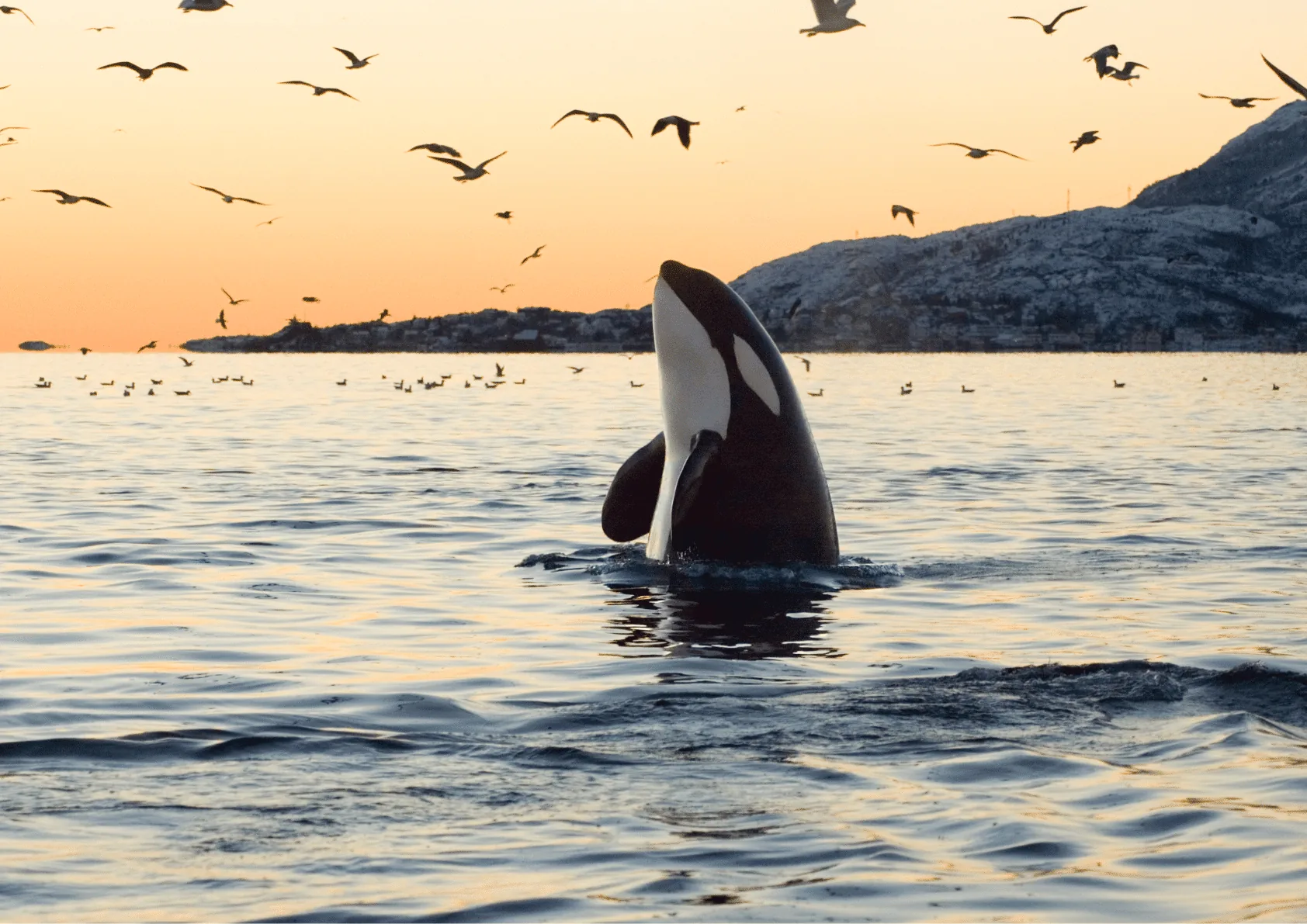
They are called killer whales.
The name is dramatic. It is memorable. It triggers fear. And even if they attack sailboat rudders in the Iberian Peninsula, it couldn’t be further from the truth.
Orcas are not whales. They are dolphins.
This is not a poetic opinion or a modern rebranding. It is a biological fact.
Orcas belong to the dolphin family Delphinidae, alongside bottlenose dolphins and other highly intelligent marine mammals.
They share the same evolutionary lineage, the same brain complexity, the same social structures, and the same emotional depth. They are simply the largest dolphins on Earth.
Size fooled us. Humans have always struggled with scale. Big things feel more dangerous. But biology does not care about our instincts.
A wolf is still a wolf whether it weighs forty kilos or eighty. An orca is still a dolphin, whether it measures three metres or eight.
Understanding orcas requires slowing down and letting go of fear.
Orcas live in tightly bonded family groups called pods. These are not random gatherings. They are structured societies, often led by elder females who carry decades of accumulated knowledge. These matriarchs remember feeding grounds, seasonal movements, dangers, and hunting strategies. They teach the young. They coordinate the group. They hold memory itself.
What makes orcas truly exceptional is culture.
Different orca populations behave differently, eat different prey, use different techniques, and even communicate with distinct vocal patterns. These differences are learned, not inherited genetically. Orcas pass knowledge from one generation to the next in ways strikingly similar to human societies. If humans were not the dominant species, orcas might be the next candidate.
Some orca groups hunt fish. Others hunt seals. Others hunt sharks. Some hunt whales. And they do so with precision, cooperation, and restraint. An orca does not kill randomly. It does not hunt what it does not recognise as prey. This alone dismantles the myth of the indiscriminate killer.
So how did such a complex animal end up with such a crude name?
The answer lies far north, in the Arctic, and deep in the history of human survival.
For Inuit communities, whales were not symbols. They were life. Everything depended on them. Food, warmth, tools, shelter, trade, and cultural continuity. To hunt a whale was not a conquest. It was a necessity. Respect for the animal coexisted with reliance on it.
In this context, orcas were not demons. They were rivals.
Orcas hunted whales. Efficiently. Strategically. Often cooperatively.
They competed directly with Inuit hunters for the same essential resource.
The Inuit named them accordingly. They were whale killers. Animals that kill whales. The meaning was clear, practical, and free of moral judgment.
But when European explorers encountered the Inuit language and culture, nuance was lost. Words were filtered through foreign ears, foreign priorities, and a worldview that often misunderstood indigenous knowledge. Whale killer was inverted. The emphasis shifted. The "killer whale" was born.
That single reversal changed everything.
The animal was no longer defined by what it hunted, but by an abstract identity as a killer. The focus shifted from ecology to fear.
Orcas became the villains of the sea. Dangerous by default. Violent by nature.
Language does this. Words shape perception. Perception shapes action.
For centuries, orcas were hunted, shot, poisoned, and exterminated because they were believed to be threats. Fishermen blamed them for declining catches. Whalers saw them as competitors. Fear justified cruelty. Few stopped to ask whether the story itself was wrong.
Here lies one of the great ironies of history. Humans accused orcas of doing exactly what humans had done for centuries: hunting whales, cooperating, passing knowledge, and maximising efficiency. We recognised our own reflection and called it monstrous.
Another fact rarely mentioned is this: there is no documented case of a wild orca deliberately killing a human in the ocean. None. Despite their size, strength, and intelligence, wild orcas have shown remarkable restraint towards humans. We are not prey. We are not competitors. We do not belong in their ecological equation.
When incidents have occurred, they have almost exclusively involved captivity. Artificial environments. Broken social structures. Psychological stress. Confined intelligence. Those tragedies tell a story about captivity, not about orcas.
The name killer whale survived because it fit a narrative we were comfortable with.
A simple monster. A clear enemy. A justification.
But the truth is more uncomfortable and far more interesting.
Orcas are apex predators, yes. They are powerful, yes. They are capable of killing whales, yes. But they are also intelligent, social, emotional, and deeply cultural animals. They regulate marine ecosystems. They shape prey behaviour. They influence ocean balance in ways we are only beginning to understand.
Calling them whale killers restores accuracy. It reconnects the name to behaviour, not fear. It honours indigenous knowledge instead of distorting it. It reminds us that words matter, especially when they shape how we treat the living world.
Sometimes, changing two words is enough to dismantle centuries of misunderstanding. And sometimes, telling the correct story is the most radical act of all.