The Captain’s Duty to Protect Ship and Crew
A lot of people have been asking me about the captain's duty to protect the ship and crew. As a lawyer, I may help by saying that:
The master of a vessel is not merely responsible for the technical navigation of the ship; he is the ultimate guarantor of the safety of human life, the vessel, and its cargo. His function carries legal weight far beyond navigation itself, involving criminal, civil, and administrative responsibilities that cross national borders.
In Iberian waters, where vessels sail under a variety of flags (Portugal, Spain, Poland, France, the United Kingdom, Sweden, Denmark, the Netherlands, and Germany), the central question arises: which law applies, and how far does the master’s obligation to act in cases of danger extend?
1. The Flag State Rule and Coastal Jurisdiction
Article 91 of the United Nations Convention on the Law of the Sea (UNCLOS, 1982) establishes that every vessel must sail under the flag of a single State and is subject to its exclusive jurisdiction on the high seas.
This means that the master is primarily bound by the obligations of the flag State (Portugal, Spain, France, Poland, etc.). However, in territorial waters (up to 12 nautical miles), the coastal State's jurisdiction also applies, particularly in matters of navigational safety, environmental protection, and public order.
In addition, Article 98 of UNCLOS, together with the SOLAS Convention (1974) and the SAR Convention (1979), imposes on all masters, irrespective of flag, the universal duty to render assistance to any person in distress at sea.
2. The Legal Framework in Selected European Countries
- Portugal: Portuguese legislation on recreational navigation applies, and subsidiarily the maritime professional regime, imposing on the master the duty to employ all means to protect the crew, the cargo, and the vessel. The Penal Code (art. 10(2)) qualifies the master as a guarantor and punishes omissions. Article 32 enshrines the right of self-defence, allowing a proportional response.
- Spain: The Código de Comercio (art. 612) and the Ley de Puertos y Marina Mercante (art. 86) place the capitán as the highest authority on board. The Spanish Penal Code (art. 195) punishes failure to render assistance. Self-defence is set out in art. 20.
- Poland: The Kodeks morski (Maritime Code) and the Kodeks Karny (Penal Code) impose on the kapitan the duty to protect the crew and vessel. Self-defence is provided for in art. 25 KK.
- France: The Code des Transports and the Code Pénal (art. 223-6) require the capitaine to guarantee safety and render assistance. Self-defence is recognised in art. 122-5.
- United Kingdom: The Merchant Shipping Act 1995 and the rules of the Maritime and Coastguard Agency (MCA) impose on the master a duty of care. Self-defence arises from common law and the Criminal Law Act 1967.
- Sweden: The Sjölagen (Maritime Code) obliges the befälhavare to take all necessary safety measures. Self-defence is governed by Chapter 24 of the Brottsbalken (Penal Code).
- Denmark: The Danish Merchant Shipping Act places full responsibility for the crew on the master. Failure to assist is punishable under the Penal Code, Section 13, which also regulates self-defence.
- Netherlands: The Burgerlijk Wetboek (Book 8) regulates maritime law and imposes a duty of safety on the gezagvoerder. The Wetboek van Strafrecht (arts. 307 and 450) criminalises negligence and failure to render assistance. Self-defence is recognised in art. 41.
- Germany: The Handelsgesetzbuch (HGB) and the Seemannsgesetz place the Kapitän as the highest authority on board. § 323c of the Strafgesetzbuch (StGB) punishes omission of assistance. Self-defence is regulated in § 32 StGB.
3. Self-Defence at Sea
In all these countries, self-defence is recognised as a ground of justification:
Portugal (art. 32 PC), Spain (art. 20 PC), France (art. 122-5 Penal Code), Poland (art. 25 KK), United Kingdom (common law), Sweden (Ch. 24 Brottsbalken), Denmark (Sec. 13 PC), Netherlands (art. 41 WvSr), Germany (§ 32 StGB).
This means that the master may resort to necessary and proportionate means to repel an unlawful attack, whether by piracy, sabotage, or any other imminent threat to the crew or the vessel, including threats posed by wild animals.
4. The Primacy of Human Life and Vessel Safety
Maritime and criminal law converge on an essential principle: human life and the safety of the vessel are superior legal values, prevailing over other interests when these come into conflict.
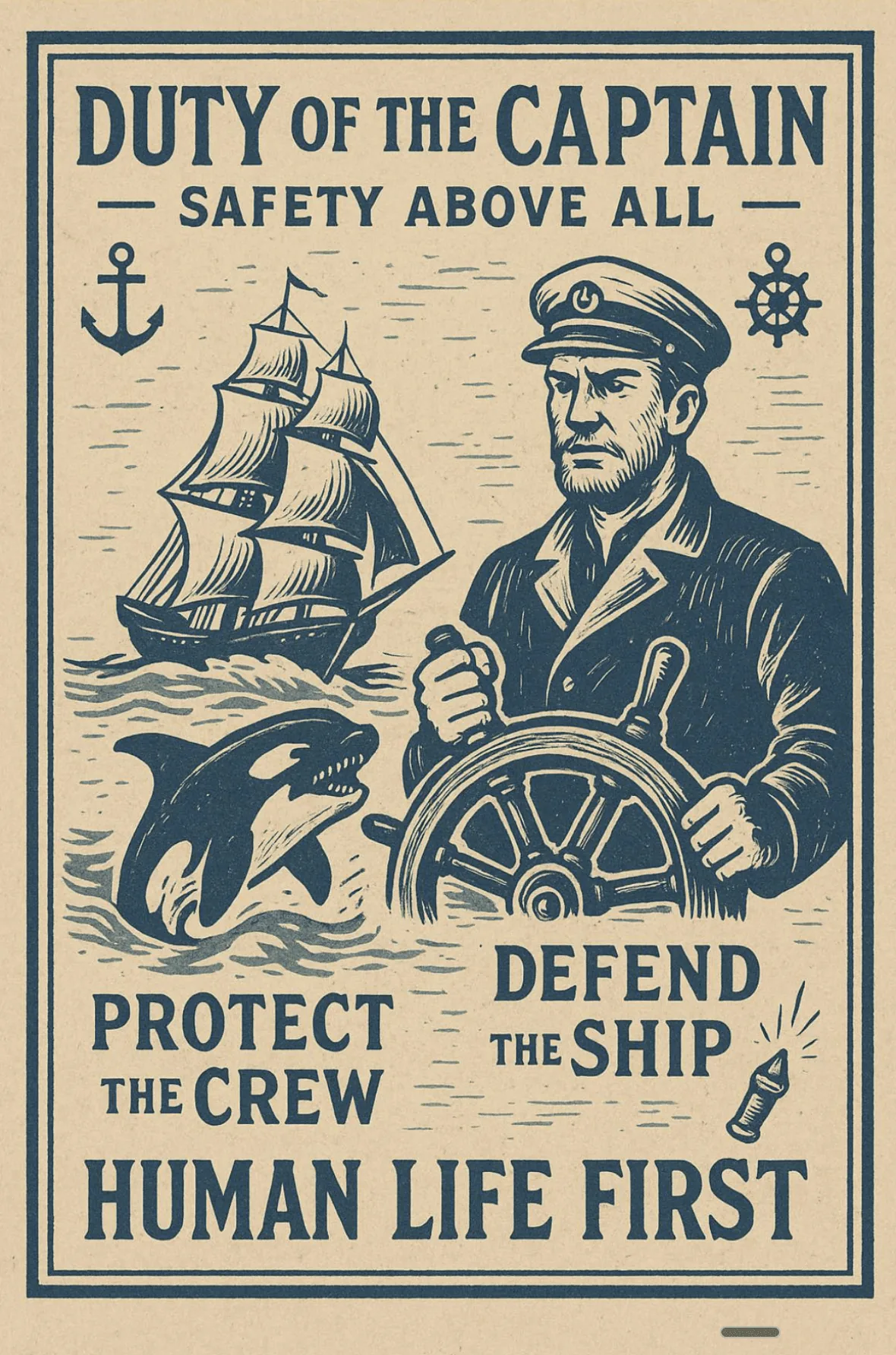
In extreme situations, such as rudder attacks by orcas, the master may be compelled to resort to means which, under normal circumstances, would constitute administrative, environmental, or even minor criminal offences.
Example: the use of firecrackers or small acoustic signalling devices to deter orcas.
- As a rule, such use may constitute an environmental violation or the unlawful use of pyrotechnics.
- However, in the face of an imminent attack threatening human lives and the vessel’s integrity, such conduct may be legally framed as a necessary and proportionate act of self-defence (art. 32 Portuguese PC; art. 20 Spanish PC; § 32 German StGB; art. 41 Dutch WvSr, etc.).
- Jurisprudence and doctrine also recognise the state of necessity (art. 34 Portuguese PC; art. 20.5 Spanish PC), which excludes unlawfulness where a lesser legal interest is sacrificed to save one of greater value, such as human life.
International law reinforces this hierarchy:
- Article 98 of UNCLOS imposes on all masters the absolute duty to protect human life at sea.
- The SOLAS Convention (1974) enshrines the safeguarding of life as the paramount priority.
Thus, the occasional and proportionate use of means which would otherwise be unlawful is fully justified where the immediate defence of the crew and the vessel is at stake.