Boxing Day Is Racing Day
The Sydney Hobart Yacht Race did not begin as a quest for glory, records, or international prestige. It began in 1945 as a simple idea among sailors who had just come out of a world at war. The original plan was little more than a relaxed post-war cruise from Sydney to Hobart organised by members of the Cruising Yacht Club of Australia.
Then Captain John Illingworth, a visiting British naval officer, suggested turning the passage into a race. With that single sentence, a legend was born. Nine yachts crossed the start line on Boxing Day that year, unaware that they were laying the foundations for what would become one of the most demanding and respected offshore yacht races on the planet.
From the very beginning, the course itself defined the event. Around 630 nautical miles down the Australian east coast, across the Tasman Sea, through Bass Strait and around the southern edge of Tasmania before finishing up the River Derwent in Hobart.
This is not a gentle route. It is a natural funnel for weather systems, cold fronts, sudden wind shifts, and steep, chaotic seas. The Sydney Hobart very quickly earned a reputation for being honest and unforgiving. Boats were not judged by how impressive they looked in the marina, but by how well they survived the passage south.
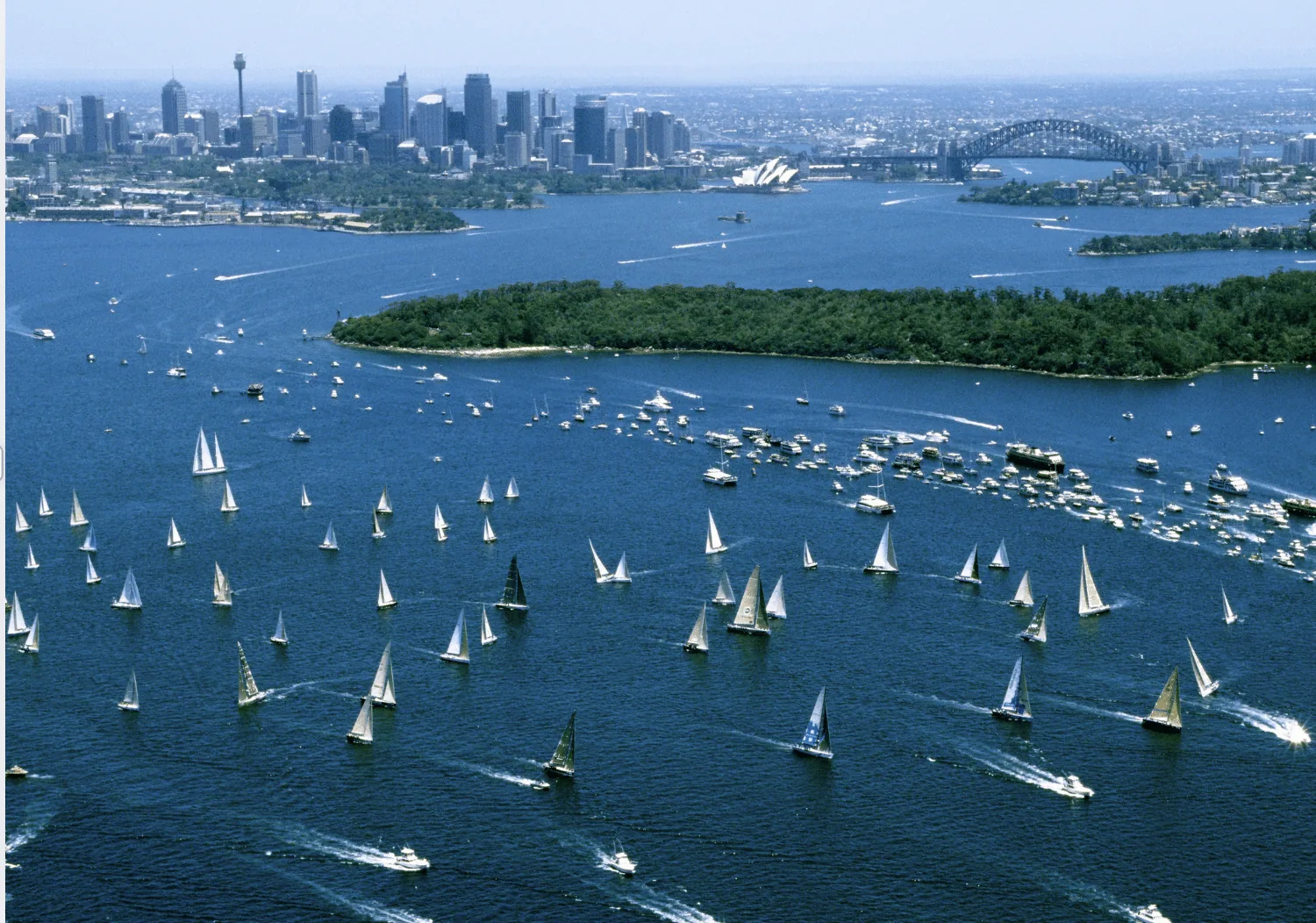
Through the 1950s, 60s, and 70s, the race grew steadily in size and reputation. Boxing Day in Sydney Harbour became a spectacle that mixed sport with summer celebration. Thousands gathered along the shoreline to watch the fleet charge towards the Heads, spinnakers flying, crews full of adrenaline and optimism.
Hobart, at the other end, became synonymous with tired smiles, salt-stained decks, and the quiet satisfaction of having finished something that could not be taken lightly.
The race developed a unique dual identity. Line Honours rewarded the fastest yacht to Hobart, while the Tattersall Cup crowned the overall winner on handicap. This meant that a well-sailed smaller yacht could beat vastly larger and more expensive rivals, reinforcing the idea that seamanship and judgment mattered as much as speed.
By the 1990s, the Sydney Hobart had become a truly international event, regularly attracting fleets of several hundred yachts and crews from around the world. Yet the race also reminded everyone why it was respected rather than romanticised.
In 1998, a violent storm system struck the fleet with devastating consequences. Several yachts were lost or abandoned, dramatic rescues were carried out, and six sailors lost their lives. It was the darkest chapter in the race’s history.
The aftermath brought deep reflection and significant change. Safety regulations, qualification requirements, and emergency preparedness were fundamentally rethought. Offshore racing around the world was reshaped by the lessons learned in that storm. The Sydney Hobart emerged not tamed, but wiser.
The early 2000s marked the arrival of the modern era. Advances in materials, design, and data enabled the supermaxi. One-hundred-foot carbon yachts began to dominate the front of the fleet, capable of extraordinary speeds and built specifically to win Line Honours and chase record times.
Campaigns became more professional, budgets increased, and rivalries intensified. Names like Wild Oats XI became part of sailing folklore, proving that consistency at the highest level is harder than any single victory. Record times were broken and chased again, but the race never became predictable. For every fast year, there was another defined by headwinds, retirements, and long, punishing days at sea.
In 2002, the race entered a new phase when Rolex became the title sponsor, and the event officially became known as the Rolex Sydney Hobart Yacht Race. This was a defining moment. Rolex did not simply attach its name to the race. It reinforced its global standing.
The partnership brought long-term stability, international visibility, and a level of storytelling that matched the scale of the challenge. Rolex already had a deep association with classic offshore sailing, and its involvement confirmed the Sydney Hobart as one of the great endurance events in world sport. Importantly, the spirit of the race was never diluted. The ocean still decided the outcome, not marketing or reputation.
In recent years, the race has continued to evolve while remaining true to its core. Technology has improved navigation, weather modelling, and onboard safety systems, yet the fundamental challenge remains unchanged.
The Tasman Sea still delivers surprises. Crews are still pushed to their physical and mental limits. Recent editions have once again shown that experience and preparation matter more than confidence alone, with severe conditions forcing retirements and reminding everyone that this is not a race that can be taken lightly. Even after decades of progress, the sea retains the final word.
Today, the Sydney Hobart Yacht Race stands as a benchmark. It is fast and slow, brutal and beautiful, modern yet deeply rooted in tradition.
It attracts supermaxis chasing glory, Corinthian crews chasing personal limits, and sailors who understand that finishing can be a victory in itself. More than eighty years after that spontaneous decision in 1945, the race still measures sailors in the most honest way possible. Not by promises made ashore, but by decisions taken at sea when fatigue sets in, the weather turns, and there is no one else to rely on.
This is why the Sydney Hobart endures. It is not just a race. It is a yearly reminder that the ocean rewards respect, preparation, and humility — and that legends are not created by comfort, but by commitment.