Round the Island Race 2026
The Round the Island Race 2026 once again showed why this extraordinary event holds such a special place in British sailing.
Since 1931, sailors have gathered in Cowes to race around the Isle of Wight. What began with just 25 boats has become one of the largest and most colourful yacht races in the world, bringing together professional campaigns, experienced club racers, family crews and sailors taking part in their first major event. Few races allow a modest wooden classic to compete on the same course, on the same day and for the same overall honour as some of the fastest racing yachts afloat.
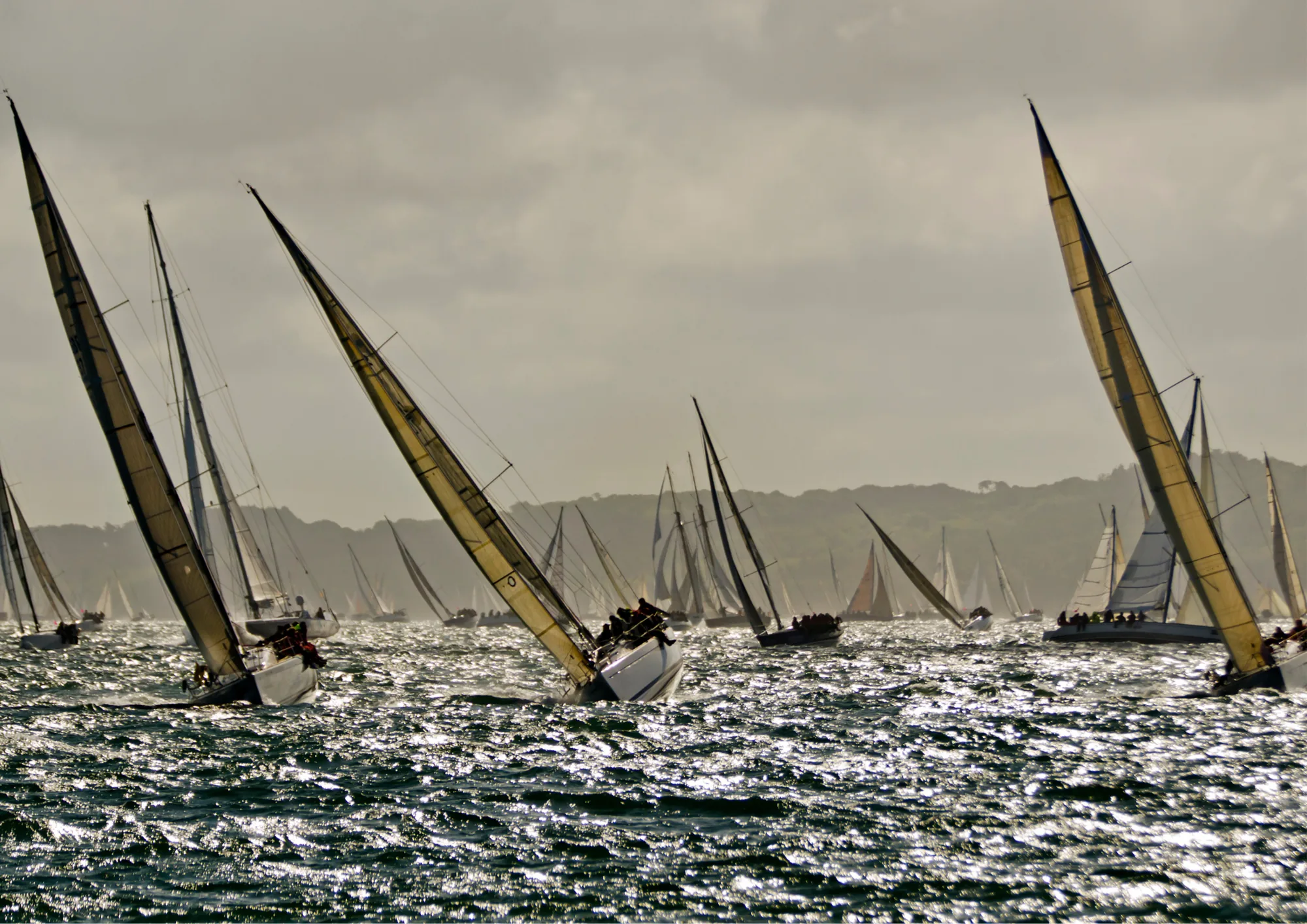
On Saturday, 11 July, around 800 boats crossed the famous Royal Yacht Squadron starting line in glorious sunshine. From Cowes, the fleet headed west through the Solent, passing Hurst before rounding the spectacular Needles. The course then followed the exposed southern coast of the Isle of Wight, past St Catherine’s Point and Dunnose, across Sandown Bay and around Bembridge Ledge Buoy. From there, the boats passed the Solent forts and Osborne Bay before returning to Cowes. In total, 50.1 nautical miles of tides, tactical decisions, sail changes and the occasional reminder that the Needles are never quite as straightforward as they appear on a chart.
Conditions were close to perfect, although there were difficult seas around the Needles and plenty of hard tacking off St Catherine’s Point. It was precisely the sort of day that makes crews forget the early start, the crowded mark roundings and the number of times someone shouted “water!” with rather more confidence than was strictly justified.
The first yacht across the finishing line was Jonny Vincent’s Pace, a powerful Ker 40+ competing in the Fast 40 category. She completed the course in an elapsed time of 6 hours, 32 minutes and 39 seconds, taking line honours after a fast and tactically demanding race.
However, one of the great qualities of the Round the Island Race is that the fastest yacht on the water does not necessarily take the greatest prize.
The coveted Gold Roman Bowl, awarded to the overall winner under IRC corrected time, went to Simon Moss and his crew aboard Tattarat, a considerably smaller and more traditional Nordic Folkboat. Tattarat recorded a corrected time of 7 hours, 38 minutes and 52 seconds, finishing less than four minutes ahead of Andrew Gilmour’s Timoa, a beautiful Stella-class yacht built by Tucker Brown in 1964.
That contrast captures the magic of this race perfectly. A high-performance Ker 40+ can charge around the island and take line honours, while a small Nordic Folkboat, sailed exceptionally well, can win the most prestigious trophy of all. Modern carbon racers, production cruisers and classic wooden yachts may be separated by generations of design, yet they all face the same tides, headlands, wind shifts and tactical choices.
But the Round the Island Race is about much more than trophies. It is one of the most enjoyable and memorable ways to circumnavigate the Isle of Wight, experience the Solent at its most spectacular and share a full day of racing with hundreds of other crews. It is competitive without losing its sense of celebration, demanding without being inaccessible and serious enough to test good sailors while still producing the sort of stories that improve considerably after the second drink in Cowes.
So, if you have never taken part, put it on the list. Prepare the yacht, gather a crew and enter the next edition. You do not need a grand-prix racing machine, a professional campaign or an Olympic medal. You need a suitable boat, a competent crew, good preparation and a willingness to spend a remarkable day sailing around one of Britain’s most iconic coastlines.
The next Round the Island Race will take place on Saturday, 10 July 2027.
One race, hundreds of boats and a thousand stories. Next year, make one of them yours. ⛵🇬🇧